











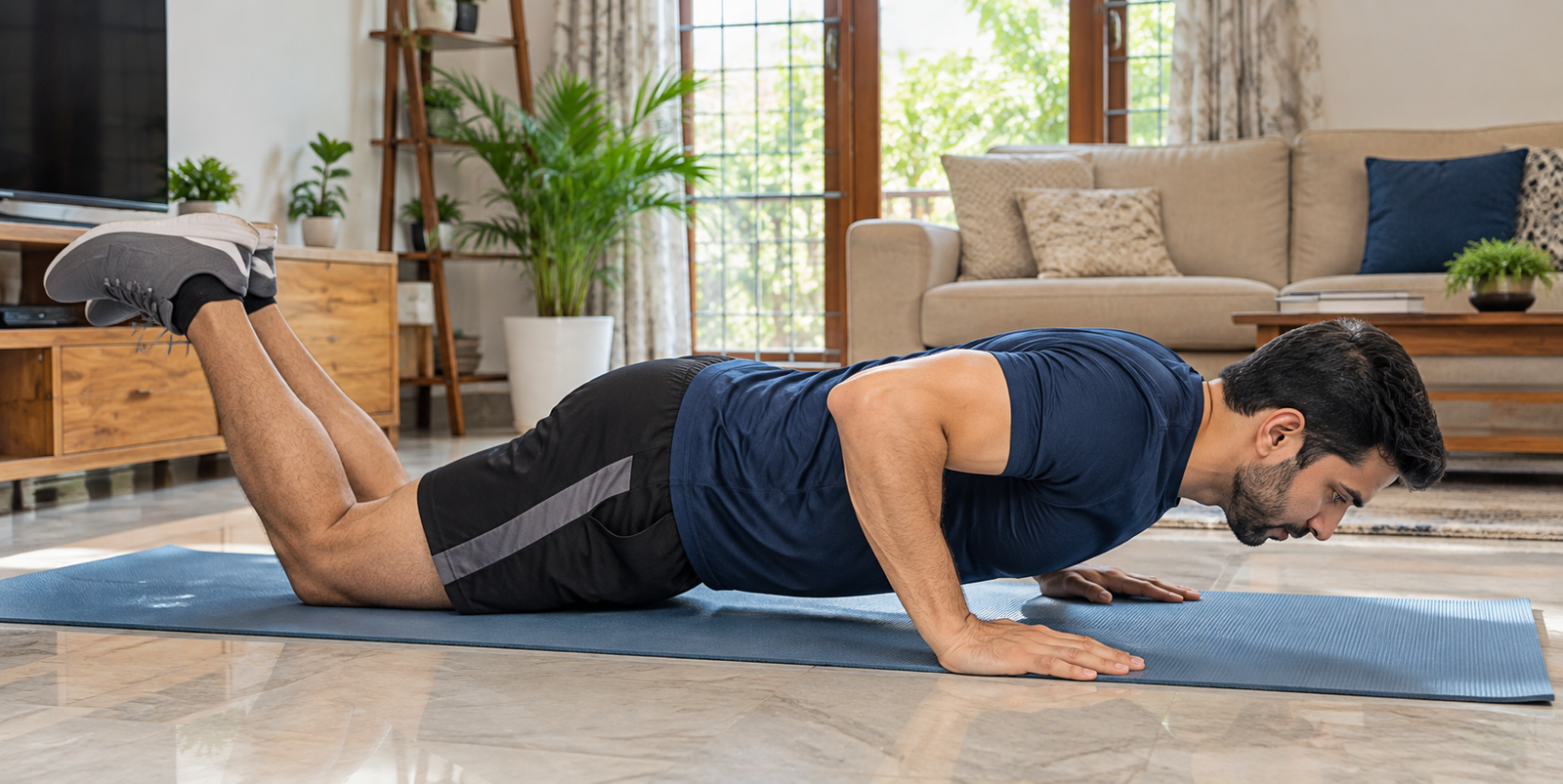
Knee push ups are a beginner-friendly version of the push-up that reduces the amount of body weight you move while still practicing the basic pressing pattern. They suit people building upper-body strength, learning push-up technique, or starting exercise at a manageable level. The goal is not simply more repetitions; it is controlled movement with solid alignment.
What Are Knee Push Ups?
A knee push-up is performed with your knees on the floor instead of your toes. This shortens the lever and makes the movement easier than a standard push-up, making it a practical starting point for beginners who cannot yet perform full repetitions with good control.
They are also useful for rebuilding basic pressing strength. However, an easier variation should still resemble a proper push-up: keep the torso organized and move the chest toward the floor rather than folding at the hips.

Knee Push Ups Benefits and Muscles Worked
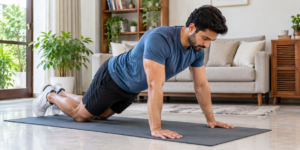
Knee push ups mainly train the chest and triceps, with the front shoulders helping the press. Your core also works to stabilize the torso throughout the movement.
Their main benefit is skill-specific strength. You practice the same horizontal pressing pattern used in regular push-ups, but with less resistance. They can also help beginners build confidence and collect quality repetitions.
Effectiveness still depends on technique. If your hips sag, elbows flare, or your range becomes very short, make the exercise easier or stop the set.

How to Do Knee Push Ups With Proper Form
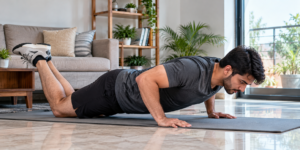
Start on a mat with your knees grounded and hands slightly wider than shoulder width. Keep the hands around chest level, wrists stacked under or close to the shoulders, and knees far enough behind the hips to create a long line from knees through torso to head. Brace your abdomen and gently squeeze your glutes.
Step-by-step technique
- Keep your head and spine neutral, with fingers spread for support.
- Inhale as you bend your elbows and lower your chest.
- Keep the elbows tracking diagonally back instead of straight sideways; about 45 degrees is a useful cue.
- Lower as far as you can while keeping control. Aim for the chest to approach the floor without collapsing.
- Exhale as you press the floor away and return to the start.
- Keep the knees, hips, torso, and shoulders moving together.
A steady descent makes it easier to spot poor form and maintain a useful range of motion.

Common Mistakes and Corrections
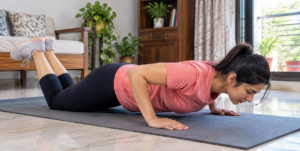
Placing the knees too close to the hands reduces the challenge and changes the body angle. Move the knees back so the torso stays long.
Flared elbows are another common problem. Bring them slightly closer to the body and guide them back as you descend.
If your hips drop toward the floor, brace your core and squeeze your glutes. Also avoid bouncing or rushing the bottom half of the repetition. A controlled rep with a comfortable range is more useful than a fast partial rep.
Knee Push Ups vs Regular Push-Ups
Both versions train the same main pressing muscles, but regular push-ups require more body support through the hands and feet. Knee push-ups are therefore easier and can build capacity before full repetitions.
| Factor | Knee Push-Ups | Regular Push-Ups |
|---|---|---|
| Difficulty | Lower | Higher |
| Support | Knees and hands | Feet and hands |
| Beginner use | Excellent | More demanding |
| Core demand | Moderate | Higher |
| Progression role | Early stage | Standard version |
Use the knee version when it allows clean, repeatable reps. Move to regular push-ups when you can maintain full-body alignment and range without compensating.

Progressing Toward Regular Push-Ups
Think of knee push ups as a bridge, not a dead end. First, build consistency with strict reps. Then add a variation that teaches the full-body position, such as incline push-ups. NASM lists modified and incline push-ups as useful beginner progressions.
A practical sequence is wall push-ups, incline push-ups, knee push-ups, then regular push-ups. You can also practice slow eccentric regular push-ups: start on your toes, lower under control, then return to the knees to reset. Progress when your form stays consistent, rather than only chasing a rep number.
Conclusion
Knee push ups are valuable when used as a technique and strength-building step. Keep the knees back, hands well placed, elbows tracking diagonally, core braced, and chest moving through a controlled range. As those habits become consistent, progress through incline or eccentric work and toward regular push-ups.


