











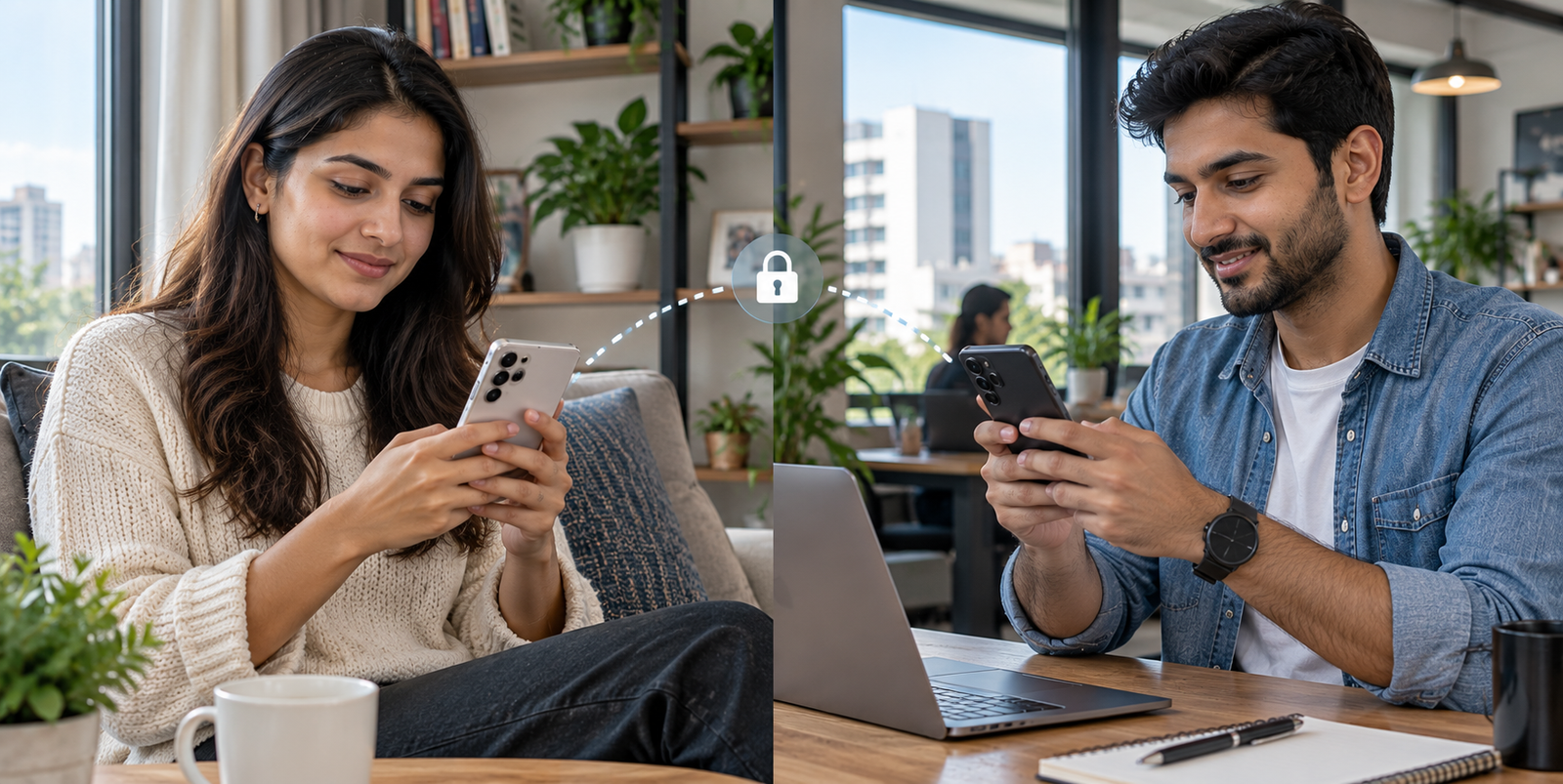
End-to-end encryption (E2EE) is designed to keep the content of a conversation readable only by the communicating endpoints. That sounds like “completely secure,” but it is more accurate to call E2EE a strong privacy layer, not a complete security system. The important question is what it protects, what it leaves exposed, and how you can verify an E2EE claim.
What Is End-to-End Encryption?
E2EE encrypts a message on the sender’s device and keeps it encrypted while it passes through networks and servers. The intended recipient’s device then decrypts it. In a properly designed system, the service carrying the message does not possess the keys needed to read the message content. This is different from simply encrypting data between your device and a server.

How End-to-End Encryption Works
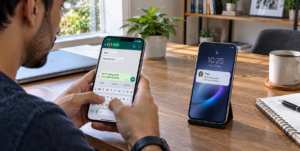
The basic flow is simple:
- Sender: You write a message on your phone.
- Encryption: The app converts the readable message into ciphertext using cryptographic keys.
- Server: The encrypted message is routed or temporarily queued without exposing the readable content.
- Recipient: The recipient’s device receives the encrypted data.
- Decryption: The recipient’s device uses the appropriate key material to recover the original message.
The server can therefore still deliver the message without being able to read its contents. Exact key-management designs vary between services, but the core principle stays the same.


E2EE vs Encryption in Transit: Why TLS Is Different
TLS protects a connection between endpoints such as your browser and a website server. The server can decrypt the data after receiving it. E2EE extends protection across the communication path so the intermediary service is not supposed to have the keys for the message content.
That distinction matters when a privacy-sensitive service says “your data is encrypted.” Ask one more question: encrypted where, and who holds the keys?
What End-to-End Encryption Protects
The main protection is confidentiality of the message or call content while it travels through the service’s infrastructure. Depending on the implementation, cryptographic authentication and integrity checks can also help detect unauthorized modification.
However, E2EE does not make every part of a communication invisible. Routing information and other metadata can remain observable. NIST’s definition explicitly notes that routing information can remain visible even when communications are encrypted.


What End-to-End Encryption Does Not Protect
First, E2EE cannot protect a compromised endpoint. If malware, a malicious app, or an attacker with access to an unlocked phone can see the message after decryption, encryption has already done its job.
Second, metadata may still reveal useful context, such as identifiers, timing, or delivery information, depending on the service.
Third, backups need separate attention. A chat can be E2EE during messaging while a backup follows a different protection model. For example, WhatsApp provides an optional end-to-end encrypted backup feature that adds protection to cloud backups.
Finally, E2EE cannot protect you from the recipient intentionally sharing, photographing, forwarding, or exposing the decrypted content.


Real-World Examples of E2EE
Signal states that its messages and calls are always end-to-end encrypted and that its service cannot decrypt message content. WhatsApp says personal messages, calls, media, voice messages, and documents are protected by E2EE by default. Google Messages supports E2EE for eligible RCS conversations between Google Messages users; SMS and MMS are not E2EE.
These examples also show why the words “E2EE” are not enough by themselves. Availability can depend on the conversation type, participating apps, settings, or other conditions. Google Messages, for example, provides encryption only for eligible RCS conversations and offers key verification.
Benefits and Limitations of End-to-End Encryption
| Benefit or limitation | Why it matters |
|---|---|
| Privacy | Keeps message content away from the service handling delivery. |
| Confidentiality | Reduces the value of intercepted ciphertext. |
| Integrity | Authenticated encryption can help detect altered messages. |
| Endpoint dependence | A compromised phone can expose decrypted content. |
| Metadata limits | Encryption may not hide who communicates or when. |
| Backup considerations | Stored copies need their own security controls. |
How to Evaluate an E2EE Claim
Before trusting an app, look for specific documentation rather than a generic “encrypted” badge. Check whether E2EE is on by default, what types of conversations qualify, how keys are verified, whether backups are separately encrypted, and what metadata the provider retains.
Independent technical documentation, source-code availability, security audits, or a clear key-verification process can also provide more confidence. Signal explains the use of safety numbers for verification, while Google Messages provides verification options for eligible encrypted conversations.
Conclusion
So, is end-to-end encryption completely secure? No. It is one of the strongest ways to protect communication content from intermediaries, but it cannot secure a compromised device, erase metadata, or automatically protect every backup and copy. Treat End-to-End Encryption as a strong layer in a broader security strategy: use reputable software, keep devices updated, protect screen access, review backup settings, and verify the provider’s actual E2EE implementation.


